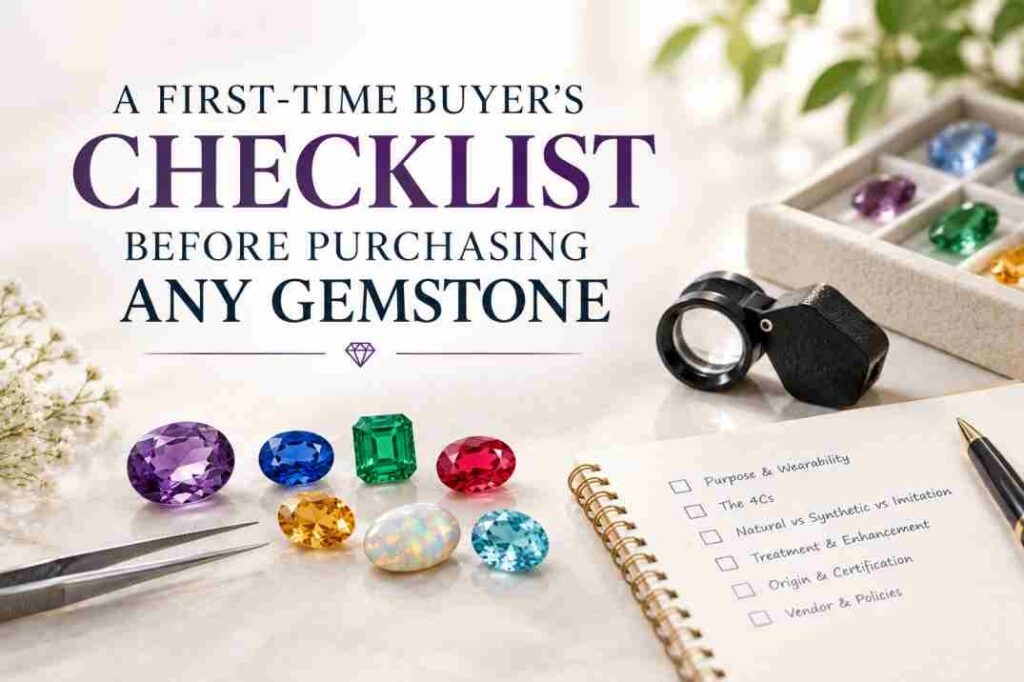
The journey of buying your gemstone becomes more exciting and less frustrating when you know exactly what you are holding – meaning every gem carries uniqueness and flaws that need to be well evaluated. In the gemstone world, the term ‘inspecting’ means looking closer. It is the art that every gem buyer needs to have to analyze a gem’s natural inclusions, cut precision, and color zoning, so that you can pay for genuine quality rather than surface charm.
If you still find yourself struggling with how to buy gemstones, then this guide is for you. With this ultimate beginner’s gemstone buying guide, you will understand everything that you need to know before spending your money. Here we will mention a simple checklist that you can follow anytime you shop for gems, whether online or offline.
Know Your Purpose & Wearability
Before comparing or buying gems, you first need to start with the purpose of your purchase and how the gem is gonna be used. For example:
For everyday rings and bracelets: a durable stone is required. Choose stones with excellent Mohs hardness (aim for 7 or higher) like sapphires, rubies, and topaz.
For occasional wear and low-impact jewelry: you can buy delicate stones like opal, tanzanite, and emerald. Pendants, Earrings, and brooches don’t face constant friction, and these stones are a suitable choice for these jewelry designs.
For Loose collections or investment purposes: focus on rarity, origin, and untreated quality rather than daily wearability.
Master The Gemstone 4Cs
Just like diamonds, colored gems are evaluated by four primary factors, though they are prioritized differently:
Color: One of the most important factors affecting beauty and value. Look at hue, tone, saturation, color distribution, brightness, and color zoning when relevant. Vivid bright colors drive the highest value.
Clarity: Having minor natural inclusions is very common in colored gems. Expect some flaws, but ensure the stone is eye-clean, meaning no major cracks or clouds are visible to the naked eye.
Cut: A well-cut gem can interact with the light beautifully, while a poor cut can make even an attractive material appear dull or uneven. Look for good symmetry, even facet arrangement, good light return, clean polish, and no obvious chips or significant cutting damage.
Carat: It tells you how much the gem weighs. Always remember that different gems have different densities. For example, a 1-carat sapphire will look smaller than a 1-carat emerald because sapphires are heavier.
Understand Synthetic vs. Natural vs. Imitation
Before buying loose gemstones, always remember to clarify what type of stone you are seeing:
| Type | What it Means | Value & Rarity |
| Natural | They are mined directly from the Earth. | |
| Synthetic (Lab-Grown) | They are formed in labs by humans and possess the exact same chemical, optical, and physical properties as a natural stone | Significantly cheaper and hold lower resale value. |
| Imitation (Simulant) | They are made of glass, plastic, or different cheap materials to look like a premium gem. For example, cubic zirconia simulates a diamond. |
Treatment & Enhancement Disclosure
Almost 80% of the natural gemstones you see in the market undergo some form of treatment to enhance their color or clarity. While these treatments are widely accepted in the trade, full disclosure from the seller is mandatory.
Common Treatments: heat treatment is common in sapphires or rubies, and traditional oiling is standard for emeralds.
Drastic Treatments: Fracture filling, dyeing, surface coating, glass filling, or heavy irradiation treatments can significantly decrease the gem’s value and durability, and cause color fading over time
The Rule: Always ask the supplier if the stone is treated and check that the specific treatment is noted on your invoice.
Origin & Lab Certification
This is one of the most important natural gemstone buying tips – never complete a high-value gem purchase based on verbal promises alone. Premium or investment-grade gems require a third-party grading report, and it should be non-negotiable.
Always demand a certificate from independent, reputable organizations like GIA, GRS, or AGTA. Verify that the certificate details the exact gemstone species, dimensions, weight, treatment status, and origin.
For certain gems like Burmese rubies or Colombian emeralds, the country of origin heavily influences the price, value, rarity, and desirability. However, in the gemstone quality checklist, origin should not be treated as a universal quality ranking.
Evaluate the Vendor & Purchase Policies
Lastly, where to buy gemstones is just as important as what you buy. Before making any final payment, ensure your selected vendor meets these essential standards:
Ensure that your vendor deals in authentic gemstones for sale and provides you with at least a 7 to 14-day return window to inspect the stone in person.
Reliable sellers always provide high-resolution photos and 360-degree videos filmed under neutral light without using heavy color filters.
Never forget to check independent reviews, verified customer feedback, and industry affiliations.
Shop Natural Loose Gemstones With Confidence
With the right amount of knowledge, every buyer can make their gem purchasing journey exciting. None of these steps require you to become a gemologist overnight. You just need to ask the right questions before you pay, not after. This guide can be useful for anyone wishing to start collecting or investing in gems.
By remembering the essentials – identity, natural status, treatment, 4Cs, durability, price, and so on, you can make more informed choices that last a lifetime.
Recommend0 recommendationsPublished in Uncategorized