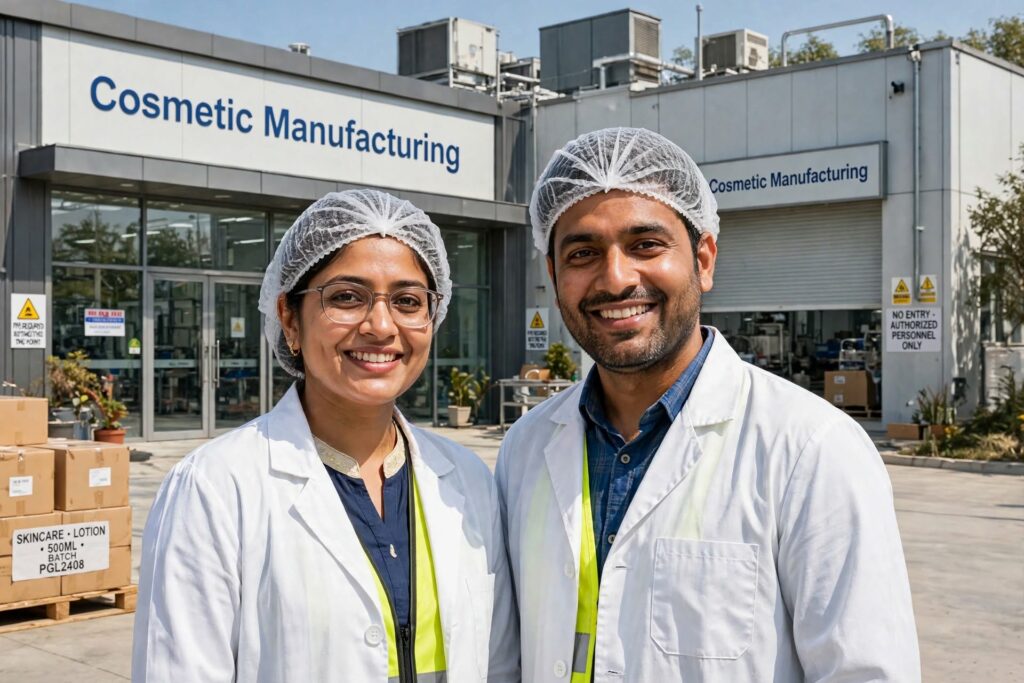
Manufacturers obtain a cosmetic manufacturing license in India by filing Form COS-5 with the State Licensing Authority (SLA) under the Cosmetics Rules, 2020. The licence is granted in Form COS-8. The application needs compliant premises, qualified technical staff, GMP-aligned systems, a complete document dossier and fee payment through the online portal. Once granted, the licence remains valid in perpetuity, subject to a retention fee every 5 years.
Demand is pushing brands to launch faster. Hair care in India grew 9% in value in 2025. Dabur reported 54% year-on-year quick commerce growth in Q4 FY2025-26. Speed only works when the regulatory groundwork is done. Manufacturers setting up a new plant or adding capacity should treat a cosmetic manufacturing license in India as a project milestone, not a last-minute paperwork step.
What Is a Cosmetic Manufacturing License?
It is the legal permit that allows a manufacturer to formulate, fill, pack, label and sell cosmetics from a specified facility.
Governing law: Drugs and Cosmetics Act, 1940, and the Cosmetics Rules, 2020
Issuing authority: State Licensing Authority (State Drug Controller) for domestic manufacturing
Central role: CDSCO handles import registration (COS-1 to COS-2) and new cosmetic permissions (COS-12 to COS-3)
Validity: Perpetual, with a retention fee every 5 years
Which Licence Route Should Manufacturers Choose?
The right route depends on who owns the premises and whether the product is new.
Own facility (COS-5 to COS-8): For manufacturers with their own plant, equipment, staff and testing arrangements.
Loan licence (COS-6 to COS-9): For brand owners without a plant who manufacture at another COS-8 licensed facility. A manufacturing agreement with the host is required. Common for D2C and private-label brands.
New cosmetic permission (COS-12 to COS-3): Novel formulations need prior CDSCO permission, supported by safety data.
Import (COS-1 to COS-2): For brands bringing finished products into India rather than manufacturing locally.
What Facility and Staffing Requirements Apply?
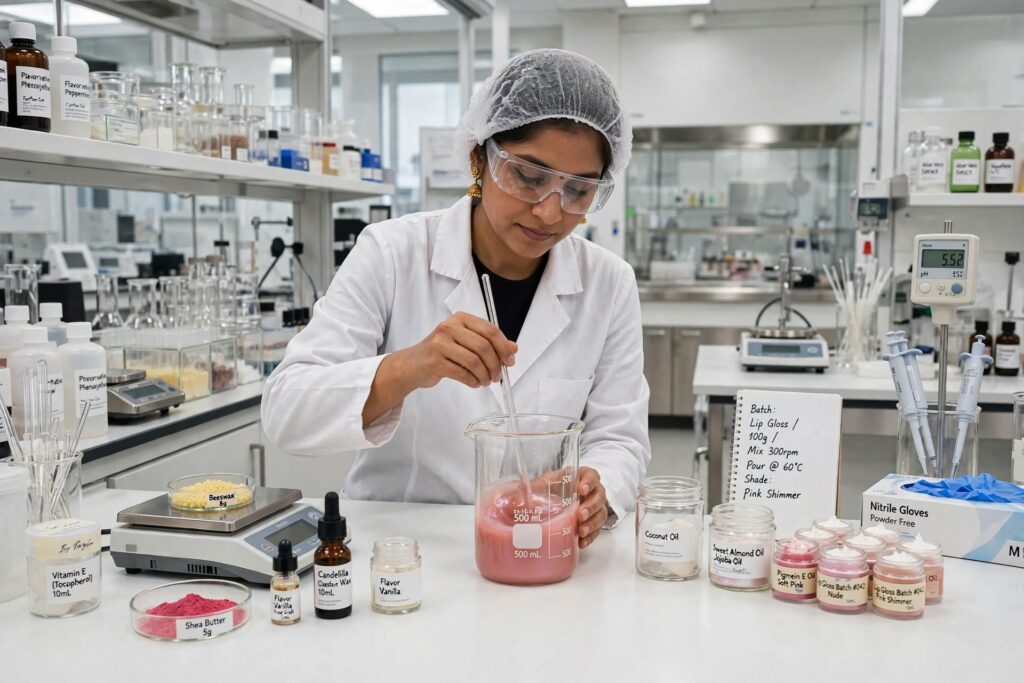
Requirements come from the Seventh Schedule of the Cosmetics Rules, 2020.
Premises
Location free from open drains, dust, smoke and odours
Separate areas for raw material storage, weighing, manufacturing, filling and packing, finished goods and quality control
Smooth, washable walls, spill-resistant flooring, adequate ventilation and drainage
Potable water supply, plus change rooms and hand-wash facilities
Plant and equipment
Equipment matched to the product range, such as homogenizers and jacketed vessels for creams, blenders and sifters for powders, and mixing tanks for shampoos
Utilities such as DM water, steam or chilling, where the process needs them
Technical staff
At least one whole-time technical person supervising manufacture
Qualifying routes include a Diploma in Pharmacy, registration under the Pharmacy Act, 1948, an Intermediate pass with Chemistry, or a bachelor’s degree in Cosmetic Technology
Testing
An in-house laboratory meeting Eleventh Schedule requirements, or an approved NABL-accredited external laboratory with the right scope
Which Documents Are Required?
Documentation quality is the biggest factor in how fast an application moves. A typical dossier includes:
Cover letter and filled Form COS-5 or COS-6
Site master file describing the facility, processes and quality systems
Ownership deed or lease agreement for the premises
Plant layout drawings showing production, storage and QC zoning
List of products, and list of plant and machinery with make, model and capacity
Qualification and employment proof of technical staff
GMP self-declaration and product compliance undertaking
Constitution documents, PAN, GST registration and fee receipt
Consent to Establish and Consent to Operate from the State Pollution Control Board, plus Fire NOC and factory licence where applicable
Product formulas, specifications, process narratives and draft labels
Manufacturing agreement with the host manufacturer (loan licence only)
What Is the Step-by-Step Application Process?
Register the entity. Complete incorporation, PAN, GST and trade licence.
Ready the facility. Finish premises, install and validate equipment, and hire qualified staff.
Arrange testing. Set up an in-house lab or tie up with an approved NABL-accredited lab.
Compile the dossier. Check it against the Second Schedule Part II and your SLA’s state-specific checklist.
File online. Submit Form COS-5 (or COS-6) with documents and fees through the applicable portal, and verify the filing mechanism with your SLA.
Respond to queries. Answer scrutiny queries promptly and completely.
Facilitate inspection. The SLA may inspect the site before or after grant.
Receive the licence. COS-8 or COS-9 is issued on approval.
How Long Does It Take?
Document preparation: 2 to 6 weeks, depending on readiness
Query response cycles: 2 to 6 weeks, often with multiple rounds
Grant of licence: within 45 days of scrutiny
Post-grant inspection: within 30 days of grant
Realistic total for first-time applicants: 3 to 6 months
If the SLA does not inspect within 30 days of grant, the licence is deemed valid.
What Changed Under the Latest Rules?
Manufacturers should track these recent updates:
The Cosmetics (Amendment) Rules, 2025 were notified through G.S.R. 513(E) on 29 July 2025.
The Central Drugs Laboratory was formally designated to handle central cosmetic testing, replacing a separate Central Cosmetics Laboratory.
Licensees now have an option in how they maintain batch, raw material and testing records.
IS 4707 (Part 2): 2025 and the new IS 4707 (Part 3): 2025 on preservatives became available on 3 September 2025.
Any new BIS standard for a listed category becomes mandatory 6 months after publication.
Formulations and labels should be reviewed against the updated ingredient standards before filing.
What Compliance Continues After Approval?
A perpetual licence still needs continuous discipline.
Inspections: At least once every 3 years, with Form COS-11 inspection book kept on site
Retention fee: Due before the 5-year anniversary; a late fee of 2% per month applies within 180 days of the due date
Deemed cancellation: Non-payment beyond 180 days
Change notifications: Changes in labelling, composition, testing or specifications must be reported within 30 days
Constitution changes: A change in the firm’s constitution needs a fresh licence within 6 months
Labelling: Product name, manufacturer details, Mfg. Lic. No., batch number, dates, net contents and ingredient list per Rule 34 and the Ninth Schedule
Records: Batch manufacturing and testing records kept for the prescribed period
What Mistakes Delay Licensing?
Incomplete site master file or layouts that do not match the product list
Technical staff qualification gaps
Product categories that exceed plant capability
Missing BIS specification citations and incomplete draft labels
Ignoring state-specific SLA checklists
How Can IMARC Engineering’s Expertise Help?
A licence application is only as strong as the facility behind it. IMARC Engineering, an EPCM advisory firm based in Noida, supports cosmetic manufacturers on both the regulatory and engineering sides.
Facility design: GMP-aligned plant layouts, process flow and material movement planning that match Seventh Schedule zoning
Equipment and utilities: Specification and selection of mixing, filling and packing lines, and planning of water, HVAC and steam systems
Factory automation: Automation and digital monitoring setup for batch tracking, in-process controls and electronic batch records, which supports traceability and audit readiness
Compliance readiness: SOP development, documentation and mock inspections ahead of the SLA visit
Execution support: Project scheduling, vendor coordination and commissioning so the plant is inspection-ready on time
Planning a cosmetic plant or licence application? Speak with an IMARC Engineering specialist for a scoping consultation: https://www.imarcengineering.com/contact?service=regulatory-approval-and-licensing&subservice=cosmetic-manufacturing-license
Conclusion
Obtaining a cosmetic manufacturing licence comes down to three priorities: choosing the correct route, submitting a complete dossier, and sustaining compliance after grant. Own-facility and loan-licence applications follow different paths, and novel cosmetics need separate CDSCO permission. With the 2025 amendments and updated IS 4707 standards now in force, manufacturers who plan facility, documentation and quality systems together can move from application to production with fewer query cycles.
Recommend0 recommendationsPublished in Uncategorized