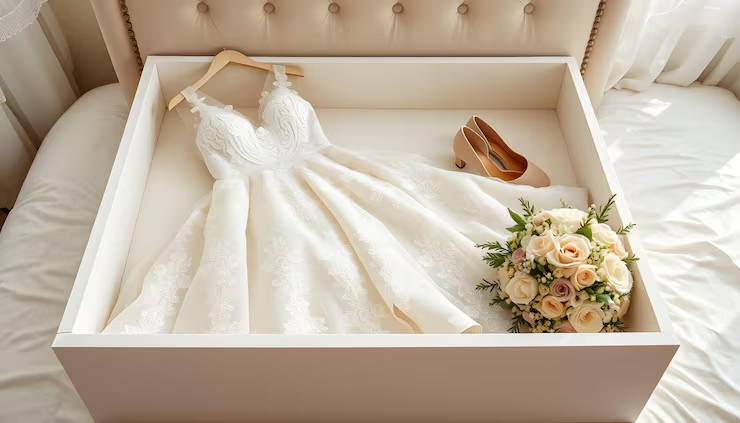
The market for a wedding gown preservation kit has grown considerably in recent years, and so has the variation in quality. Not every kit sold under the label of “preservation” is built from materials that genuinely protect fabric over the long term. Understanding what separates an archival-quality kit from a standard storage product — and what details most buyers miss — helps ensure the investment actually delivers the protection the dress deserves.
The Material Difference That Actually Matters
The single most important factor in any wedding gown preservation kit is whether the storage materials are genuinely acid-free and buffered. These two terms are frequently used interchangeably in product marketing, but they refer to different things.
Acid-free means the material has a neutral pH at the time of manufacture — it won’t immediately react with fabric fibers. Buffered means the material has been chemically treated to maintain that pH neutrality over time, even as it interacts with the stored garment and the surrounding environment. An unbuffered acid-free product can become acidic within years; a buffered one maintains neutrality for decades.
For a wedding dress intended to last a generation or more, buffered materials are not optional. A kit that doesn’t specify buffering in its product description should be treated with caution.
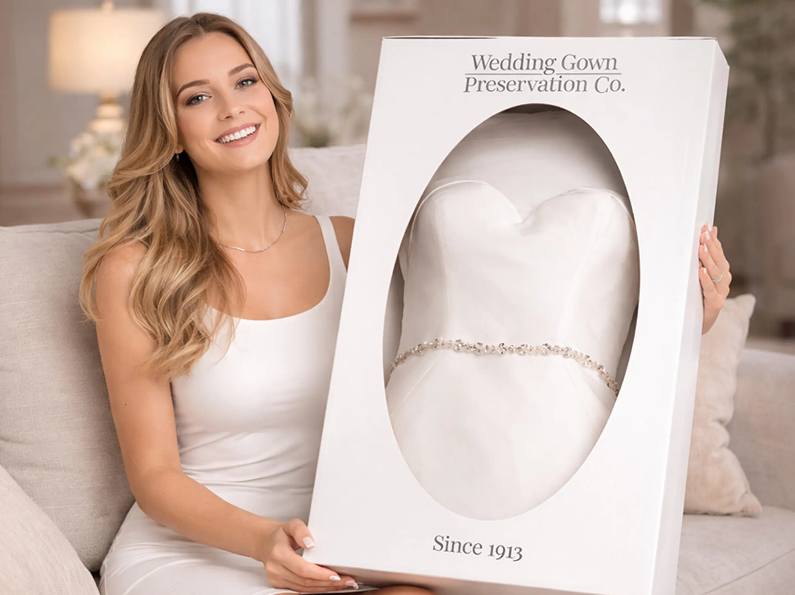
Photo credit Trusted Wedding Gown Preservation
Box Construction and Seal Design
The storage box itself matters beyond its material composition. A well-designed preservation box should be sturdy enough to resist compression from being stacked or stored under other items. It should have a close-fitting lid that keeps out dust and pests without sealing the contents completely airtight — fabric needs minimal airflow to prevent moisture buildup.
Some kits use a chest-style design with a hinged lid; others use a separate lid box. Either design works when constructed from archival materials. What to avoid is any box that uses metal fasteners, standard cardboard inserts, or glossy coatings — all of which can off-gas compounds that transfer to fabric over time.
A quality wedding gown preservation kit will typically include a generous quantity of tissue — enough to pad multiple fold points and stuff the bodice — rather than a minimal amount that leaves large sections of fabric in direct contact with the box surface.
Fabric-Specific Considerations
No kit works identically for every dress. The fabric composition of the gown significantly affects how it should be folded, padded, and stored — and whether at-home preservation is appropriate at all.
Silk gowns are particularly sensitive to moisture and require careful folding to avoid stress lines at crease points. Organza and chiffon are lightweight and can be layered with tissue relatively freely, but are vulnerable to snagging on any rough surface. Heavy ball gowns with structured tulle underskirts need significant tissue volume to prevent compression of the skirt structure. Dresses with extensive beading or embroidery require extra padding around embellished areas to prevent beads or threads from catching on adjacent fabric sections.
According to the Getty Conservation Institute’s guidelines on textile storage, the mechanical stress of unsupported folds is one of the leading causes of long-term fiber damage in stored garments — underscoring the importance of thorough, careful padding throughout the folding process.
Cleaning Before Preservation: A Non-Negotiable Step
A preservation kit — regardless of quality — cannot compensate for an uncleaned dress. Organic residue from the wedding day, including perspiration, body oils, food, and beverages, continues to degrade fabric chemically during storage. Sugar-based stains from champagne or cake are virtually invisible immediately after the event but oxidize into permanent discoloration within months.
Professional cleaning before packing is the standard recommendation from textile conservators for precisely this reason. The cleaning method should be matched to the dress fabric — wet cleaning for water-soluble stains on appropriate fabrics, dry cleaning solvents for oil-based marks, and specialist treatment for embellished areas. A preserved but uncleaned dress is a timed problem rather than a solved one.
Storage Environment: The Variable Most Kits Don’t Control
Even the best preservation kit performs only as well as the environment it is stored in. Temperature fluctuations cause fabric fibers to expand and contract repeatedly, weakening them over time. High humidity promotes mold and mildew. Ultraviolet light — even indirect ambient light — causes color fading and fiber degradation in natural fabrics.
Ideal storage conditions are consistently cool (65–70°F), moderately dry (45–55% relative humidity), and dark. Main-floor interior closets in climate-controlled homes meet these criteria far better than attics, basements, or garages. Elevating the storage box off the floor provides additional protection against localized moisture.
Conclusion
The right wedding gown preservation kit does more than provide a box and some tissue — it delivers archival-grade materials engineered to remain chemically stable for decades, paired with a design that protects the physical structure of the gown. Evaluating kits on material quality, buffering, box construction, and tissue quantity — rather than price alone — is the most reliable way to choose a product that genuinely earns the word preservation. Combined with professional pre-cleaning and appropriate storage conditions, a quality kit gives a wedding dress the best possible chance of lasting well beyond the lifetime of the occasion it represents.
Recommend0 recommendationsPublished in apparel, Bridal